
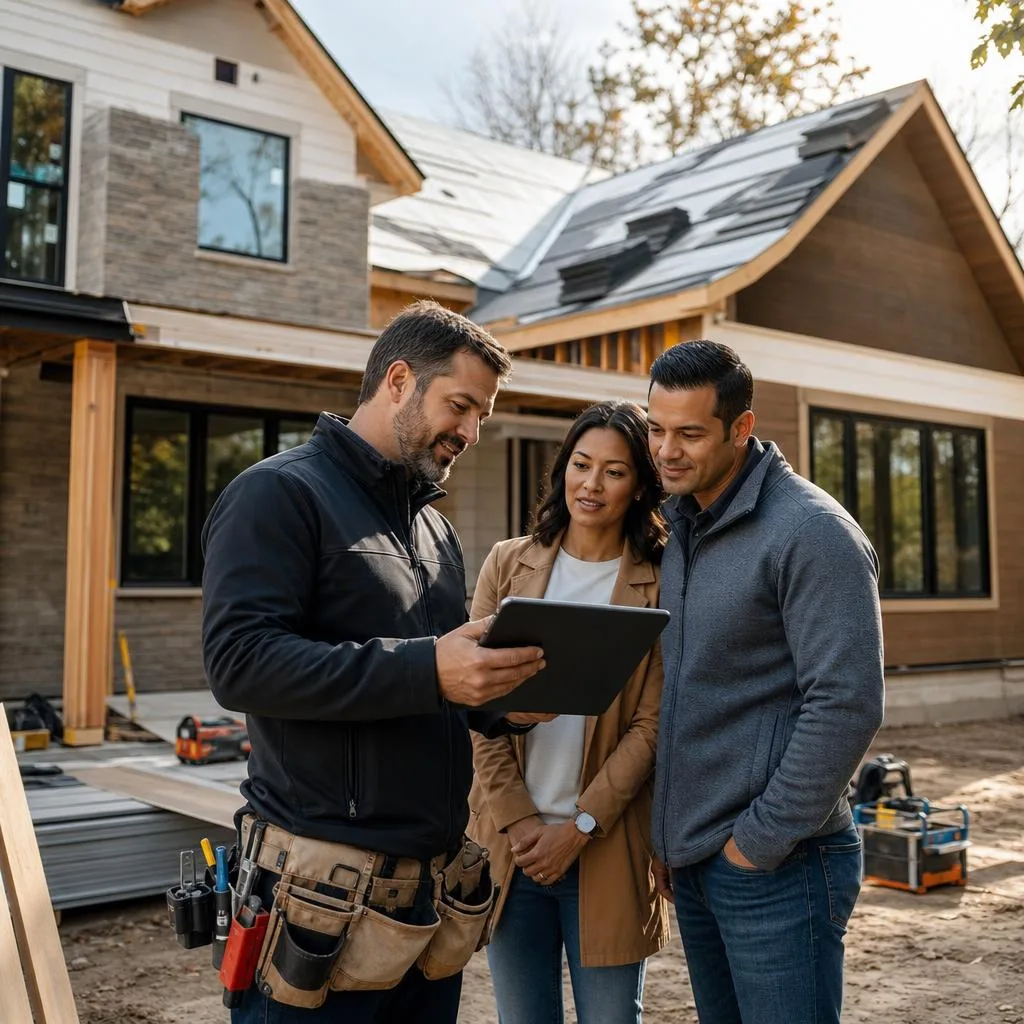
Contractors win new customers by becoming easy to find, easy to trust, and easy to contact at the exact moment a buyer needs help.
Key takeaways
- Use local search, reviews, and clear service pages to attract ready-to-buy customers.
- Respond to every call and form quickly with a simple follow-up process.
- Track leads from first contact to booked job so you can invest in what works.
- Build trust with useful answers, transparent pricing guidance, project proof, and professional communication.
How can contractors get new customers from local search?
Contractors can get new customers from local search by optimizing their Google Business Profile, service pages, reviews, and location information. Most buyers search for a nearby provider when a roof leaks, a renovation becomes urgent, or they are ready to build.
Search behavior also reveals strong buying intent. Someone searching for the best home builder near me is not looking for a general article. They are comparing companies that could earn a large project. Your online presence must help that person decide quickly.
What should a contractor include on a local service page?
A strong local service page should explain what you do, where you work, why customers trust you, and what the next step is. It should also make contacting your team simple on a phone.
- A clear headline that names the service and location.
- Photos of completed projects, crews, equipment, or finished spaces.
- Licensing, insurance, warranty, and experience information where relevant.
- Customer reviews that mention the type of work completed.
- A visible phone number, contact form, and short request-a-quote button.
- Answers to common questions about timing, materials, permits, and payment.
For example, a roofing company should create pages for roof repair, roof replacement, emergency roofing, and the towns it serves. A homeowner who searches “contact roofing contractor” should land on a page with one obvious action: call, message, or request an inspection.
How do reviews help contractors win new customers?
Reviews help contractors win new customers by reducing risk and proving that the business delivers what it promises. Buyers often compare several companies, and recent, detailed reviews can move your company ahead of a competitor with a similar service.
Ask for a review after a clear success point, such as a completed inspection, finished installation, or resolved service issue. Make the request personal and explain that honest feedback helps other property owners choose with confidence. Never offer rewards in exchange for positive reviews or write reviews for customers.
What makes a contractor review more persuasive?
A persuasive review describes the customer’s problem, the contractor’s response, the quality of the work, and the final result. These details give future buyers useful evidence instead of a vague five-star rating.
| Weak review signal | Stronger trust signal |
|---|---|
| “Great company.” | “The crew replaced our damaged roof in three days and kept the site clean.” |
| Old reviews with no recent activity | Fresh reviews from the past few months |
| Only perfect ratings | A strong overall rating with thoughtful responses to concerns |
| Stock project photos | Real images from local jobs |
Respond to every review. Thank customers who had a good experience, and address complaints without arguing. A calm response shows prospective customers how your team handles problems before they hire you.
How should contractors turn website visitors into leads?
Contractors turn website visitors into leads by giving each visitor a clear next step, a reason to act, and enough information to feel safe making contact. A page that only lists services may attract traffic but often fails to create conversations.
Use calls to action that match the customer’s situation. “Request a roof inspection” is more useful than “Submit.” “Book a design consultation” is more specific than “Learn more.” Place the call to action near the top of the page, after proof of quality, and again at the bottom.
What should be on a contractor contact form?
A contractor contact form should ask only for information needed to start the conversation. Short forms usually produce more inquiries than forms that feel like a full application.
- Name and best phone number.
- Email address, if written estimates or photos are needed.
- Service requested and property location.
- A short description of the project or problem.
- Preferred contact method and timing.
Add a privacy note and tell visitors what will happen next. For example: “We will review your request and call within one business day.” If customers can upload photos, explain the accepted file types and why images help your team prepare.
How fast should a contractor respond to a new lead?
A contractor should respond to a new lead as quickly as possible, ideally within five minutes during business hours and within a clearly stated time after hours. Fast contact improves the chance that the customer will speak with your team before choosing another provider.
Speed does not mean sending a careless message. The first response should confirm receipt, show that a real person is involved, and set a specific next step. If a caller reaches voicemail, return the call promptly and send a short text or email when appropriate.
| Lead stage | Recommended response | Purpose |
|---|---|---|
| New phone call | Answer live or return the call within 5 minutes | Capture urgent demand |
| Website form | Confirmation immediately; personal reply within 15 minutes | Set expectations and start qualification |
| Estimate requested | Schedule a visit within 1 business day when possible | Move interest toward a real appointment |
| Unanswered estimate | Follow up at least 3 to 5 times over 10 to 14 days | Recover opportunities without pressure |
What should a contractor say in the first follow-up?
The first follow-up should confirm the request, repeat the service needed, and offer a simple scheduling choice. For example: “Hi Jordan, this is Sam from Northside Roofing. We received your request about the roof leak on Oak Street. We can call today at 2 p.m. or 4 p.m.; which works better?”
Use a shared process so every employee gives a consistent experience. Clear ownership, call standards, and follow-up reminders are part of a reliable customer service infrastructure that keeps opportunities from being lost.
How can contractors use content to attract better-fit customers?
Contractors can attract better-fit customers with practical content that answers questions before a sales call. Helpful content builds trust, improves search visibility, and filters out people who are not ready or able to buy.
Write about real customer concerns instead of producing generic marketing copy. A builder could explain the difference between buying land and using a builder’s lot. A roofing company could explain when a repair is reasonable and when replacement is safer.
Which contractor content topics bring qualified leads?
The best topics address cost, timing, quality, risk, and the buying process. They should be written in plain language and connected to a relevant service page.
- “How long does a roof replacement take?”
- “What should I ask before hiring a home builder?”
- “Are new home builders on your lot responsible for site preparation?”
- “How much does a bathroom renovation usually involve?”
- “What permits are needed for this type of project?”
Include local examples where possible. Someone comparing the best local home builders wants to know whether your team understands local codes, weather, suppliers, neighborhoods, and land conditions. Specific information makes your company more credible than broad claims such as “quality service.”
How should contractors qualify new customers without losing opportunities?
Contractors should qualify new customers with a short, respectful conversation about project fit, timing, budget range, decision-makers, and location. Qualification protects your team’s time while helping genuine buyers receive the right next step.
- Confirm the service needed and the property address or service area.
- Ask what problem the customer wants to solve and when it began.
- Learn the desired timeline and whether there is an urgent safety issue.
- Discuss a realistic budget range or explain your minimum project size.
- Confirm who will approve the work and how the estimate process works.
- Schedule the next action before ending the call.
Do not treat qualification as a reason to dismiss smaller projects rudely. If the work is outside your scope, refer the person to a suitable provider when you can. A helpful interaction can lead to future work or a valuable referral.
Which numbers should contractors track to measure new customer growth?
Contractors should track lead source, response time, qualified leads, booked appointments, estimates, close rate, average job value, and customer acquisition cost. These numbers show where growth comes from and where sales are leaking.
| Metric | What it tells you | Action to take |
|---|---|---|
| Lead source | Which channels produce inquiries | Invest more in profitable sources |
| Response time | How quickly prospects receive help | Improve call routing and alerts |
| Estimate-to-job rate | How often proposals become work | Review pricing, trust signals, and follow-up |
| Average job value | Revenue per completed project | Improve packages and appropriate upgrades |
| Customer acquisition cost | What it costs to create a customer | Compare marketing cost with gross profit |
Review the numbers every month. A contractor may discover that paid advertising creates many leads but few jobs, while local referrals create fewer leads with a much higher close rate. That insight helps you make better decisions than relying on traffic or social media likes alone.
What are the best ways to build a repeatable contractor sales process?
The best way to build a repeatable contractor sales process is to document each stage from first inquiry through post-project follow-up. A written process reduces missed calls, uneven estimates, and customer confusion.
- Define your best-fit customer and the projects you want most.
- Create service pages and proof that answer their main buying concerns.
- Set response standards for calls, forms, texts, and emails.
- Use a simple customer relationship management system or shared pipeline.
- Schedule follow-ups after every estimate and record the outcome.
- Request reviews and referrals after successful project milestones.
- Review performance monthly and improve one weak stage at a time.
Consistency is a competitive advantage. Customers may find several companies offering similar workmanship, but the contractor who communicates clearly and follows through often earns the job.
What should a contractor do next to win more customers?
A contractor should begin with a focused audit of visibility, response speed, reviews, website conversion, and sales follow-up. Fix the largest leak first rather than trying to launch every marketing tactic at once.
Start by searching your main services from a customer’s point of view. Check whether your business appears, whether the information is accurate, and whether a visitor can contact you in less than a minute. Then review the last ten inquiries and identify where each one was won, delayed, or lost.
Ready to find the gaps limiting your growth? Take the Free Business Health Audit from Modern Marks Business Consultants to identify practical improvements for attracting, converting, and serving more customers.
